Sunday, October 18, 2026 · Year A
Twenty-ninth Sunday in Ordinary Time
What belongs to God
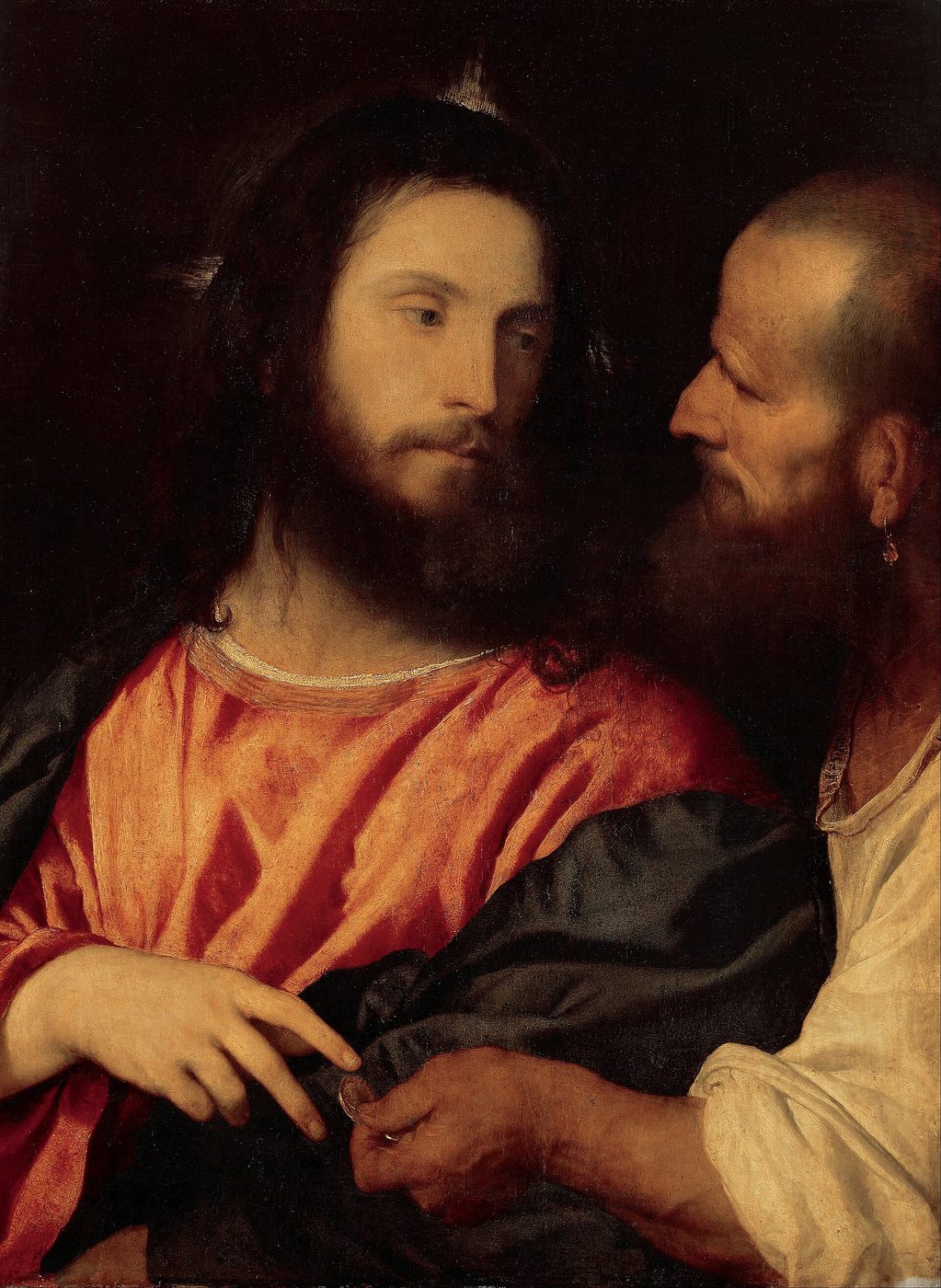
The Pharisees try to trap Jesus with a question about taxes. He answers by turning the question back on us: the coin bears Caesar’s image, but we bear God’s.
Mass Readings
- First Reading Isaiah 45:1, 4-6
- Responsorial Psalm Psalm 96:1, 3, 4-5, 7-8, 9-10
- Second Reading 1 Thessalonians 1:1-5b
- Gospel Matthew 22:15-21
Open the Mass Readings on USCCB.org →
First Reading Isaiah 45:1, 4-6
God calls Cyrus, a pagan king, by name and uses him to set His people free. Even those who do not know the Lord serve His loving plan. There is no God besides Him.
Psalm Psalm 96
The psalm invites every nation to give the Lord glory. Your praise this Sunday joins a song meant for the whole earth.
Second Reading 1 Thessalonians 1:1-5b
Paul thanks God for a young church whose faith, love and hope are already bearing fruit. The Gospel reached them not as mere words but in the power of the Holy Spirit.
Gospel Matthew 22:15-21
Jesus’ enemies try to trap Him with a question about taxes. He asks whose image is on the coin. Give Caesar what is his, He says, and give God what is God’s, including your very self.
Step Into the Story
In 539 B.C. Cyrus the Great of Persia took Babylon, reportedly without a battle, and let the exiled Jews go home. Isaiah calls this pagan conqueror God’s “anointed”: the Lord of history uses whom He pleases, emperors included. Nearly six centuries later the emperor is Tiberius, and Judea has paid its head tax straight to Rome since 6 A.D., when Judas the Galilean led a revolt against it.
- 539 B.C.Cyrus takes Babylon
- 63 B.C.Pompey takes Jerusalem
- 6 A.D.Revolt over Rome’s head tax
- 14 A.D.Tiberius becomes emperor
- This week’s scene: c. 30 A.D.The coin question
Now stand in the Temple courts, likely in the spring of 30 A.D., days before Passover. The morning is cool, but the sun is already hard on Herod’s white stone. Smoke climbs from the altar; smell the burning fat and incense. Hear the priests’ silver trumpets, the Levites singing the morning psalm, pilgrims murmuring in Aramaic and Greek. Look up: Roman soldiers from the Antonia Fortress pace the portico roofs, as at every feast.
Notice the men working toward Jesus: disciples of the Pharisees, who resent Rome, beside Herodians, who do nicely under it. First the flattery, then the trap: is it lawful to pay the tax to Caesar? Say yes, and He betrays His people. Say no, and the soldiers on the roof will hear it. He asks for a coin. Someone produces a silver denarius, a day’s wage, stamped with the head of Tiberius and the words “son of the divine Augustus.” Step close enough to see that face. Then look up at His, and wait for Him to speak.
Encounter the Lord
Put yourself in the Temple courtyard. The questioners smile too much and flatter too loudly. They have rehearsed this trap. Watch Jesus. He is not rattled. He asks for a coin, turns it over in His hand, and looks up at them, and at you. “Whose image is this?”
His heart is not set on winning an argument. He wants these men back, and He wants you. Caesar can have his coin, because Caesar stamped it. But you bear the image of the Father, and Jesus has come to reclaim what belongs to God. He is not asking for a portion of your life. He is asking for you.
This week, give something to God that you have kept for yourself: a block of time, a grudge, a habit. Each morning, look in the mirror and say quietly, “I belong to you, Lord.”
Know Your Faith
- 326-327·legitimate authority and the common good
- 376-377·duties of citizens toward the State
Called to the Common Good
Everyone is called to promote the common good, each according to his position and role, a duty flowing from your dignity as a person (CCC 1913). It begins with family and conscientious work (CCC 1914).
The Duties of Citizens
Paying taxes, voting and defending your country are moral obligations of co-responsibility for the common good (CCC 2240). But you are bound in conscience not to follow directives contrary to the moral order or the Gospel (CCC 2242).
Caesar Is Not Lord
From the beginning, Christians have confessed that Caesar is not “the Lord.” You may never submit your freedom absolutely to any earthly power, only to God (CCC 450).
Faithful Citizenship
This week, carry out one civic duty on purpose (CCC 2240), and pray for those who govern, as the Church always has (CCC 1900).
Key Takeaways
- Scripture
- Doctrine
- Sacraments
- Christian Life


- Christian Life: We owe civil authorities what is due to them, but we owe God our whole selves, because we are made in His image.
- Christian Life: Paying taxes, voting and serving the common good are real moral duties for a Christian.
- Christian Life: Only God is Lord, so we may never obey an order that goes against the moral law or the Gospel.
- Christian Life: Jesus asks us to give our whole life to God, not only part of it.
Test Your Knowledge
True or false? Tap your answer.
Isaiah shows that God can work through people who do not know Him, such as the pagan king Cyrus.
True.
Jesus’ answer about the coin means that faith is a private matter with no bearing on public life.
False: Christians share responsibility for the common good, CCC 1913, 2240.
Because we bear God’s image, God’s claim on us is total, while Caesar’s claim is real but limited.
True.
Paying taxes and voting are moral obligations, not merely civic options.
True.
A Christian must obey any law the state passes, even one contrary to the Gospel.
False: we are bound in conscience not to follow such directives, CCC 2242.
No earthly power may claim our freedom absolutely; that belongs to God alone.
True.
Promoting the common good begins in ordinary places such as family life and conscientious work.
True.
The Church teaches that Christians should keep their distance from public life to stay pure.
False: everyone is called to promote the common good according to his role, CCC 1913.
Praying for those who govern is part of the Church’s constant practice.
True.
Jesus’ main aim in this exchange was to win the argument against His opponents.
False: He wanted to win back His questioners, and us, for God.
Answers: 1 T · 2 F (Christians share responsibility for the common good, CCC 1913, 2240) · 3 T · 4 T · 5 F (we are bound in conscience not to follow such directives, CCC 2242) · 6 T · 7 T · 8 F (everyone is called to promote the common good according to his role, CCC 1913) · 9 T · 10 F (He wanted to win back His questioners, and us, for God)
Journal Prompts
When I look honestly at my calendar and my bank statement, what do they say I treat as most important?
Where in my life am I giving God only what is left over?
If I truly believed I bear God’s image, how would I speak to myself today? How would I speak to the person I find hardest to love?
What is one thing I am holding back from God that I am ready to hand over?
Talk to God
Lord Jesus, I bear Your Father’s image, and I belong to You. Free me from a divided heart. Help me give the world what I owe it, and give You everything: my time, my work, my very self. Amen.