Sunday, October 25, 2026 · Year A
Thirtieth Sunday in Ordinary Time
The two great commandments
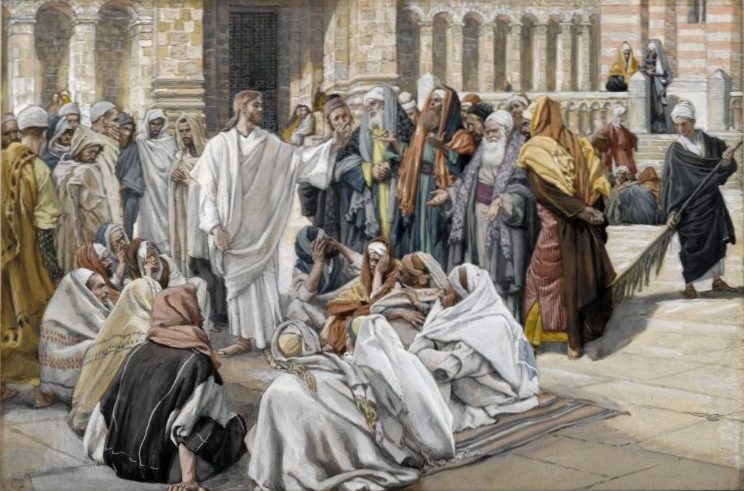
Asked which commandment is greatest, Jesus joins two: love God with everything you are, and love your neighbor as yourself. The whole Law hangs on them.
Mass Readings
- First Reading Exodus 22:20-26
- Responsorial Psalm Psalm 18:2-3, 3-4, 47, 51
- Second Reading 1 Thessalonians 1:5c-10
- Gospel Matthew 22:34-40
Open the Mass Readings on USCCB.org →
First Reading Exodus 22:20-26
God tells His people to protect the stranger, the widow, the orphan and the poor. He hears their cry, because He is compassionate.
Psalm Psalm 18
The psalmist calls the Lord his rock, his fortress and his deliverer. You can lean your whole weight on Him.
Second Reading 1 Thessalonians 1:5c-10
Paul praises the Thessalonians for turning from idols to serve the living God. Their faith had become an example to everyone around them.
Gospel Matthew 22:34-40
Asked for the greatest commandment, Jesus joins love of God with love of neighbor. Everything else in the Law hangs on these two.
Step Into the Story
The law in today’s first reading is very old. It belongs to the Covenant Code of Exodus 20 to 23, likely the Bible’s oldest collection of laws, given at Sinai to a nation of freed slaves, probably in the thirteenth century B.C. Hammurabi of Babylon had published his famous code five centuries earlier, and he did not fret over a poor man’s blanket. Israel’s God did: a cloak taken in pledge goes back before sunset, “for in what else shall he sleep?” Under Tiberius, that Law is still argued daily in Jerusalem.
- c. 1750 B.C.Hammurabi’s law code
- 13th c. B.C.The Law given at Sinai
- c. 20 B.C.Herod begins the Temple
- 14 A.D.Tiberius becomes emperor
- This week’s scene: c. 30 A.D.The greatest commandment
Climb into the Temple courts in Jesus’ last week, probably in 30 A.D. Along the south side runs Herod’s Royal Portico, 162 columns in four rows, each so thick that it took three men with arms outstretched to ring it. Feel the shade under its cedar ceiling. Listen to teachers and pupils arguing points of Law. Notice the leather prayer boxes strapped to men’s foreheads, some, Jesus remarks, made extra broad.
The Sadducees have just been silenced, and the Pharisees regroup. One of them, a scholar of the Law, steps forward to test Him. Which commandment is the greatest? Later rabbis would count 613, and a generation earlier the great Hillel had tried to fit the whole Torah into one sentence. Every man here prays the Shema each morning and evening: “Hear, O Israel.” Edge close enough to see the lawyer’s face, and wait for the answer.
Encounter the Lord
The lawyer steps forward with a test question. Jesus could have dismissed him. Instead He answers with the words every Jew prayed each morning: love the Lord your God with all your heart. Then He adds a second, and binds them together like two beams of a cross.
Look at the heart of the One who speaks. He is not reciting rules. He is describing Himself. No one has loved the Father more completely, and no one has loved His neighbor more concretely: lepers, tax collectors, you. The commandment is simply His own life, offered as yours.
This week, pick one person who is easy to overlook, the stranger, the widow, the coworker no one eats lunch with, and do one concrete act of love for them, for Christ’s sake.
Know Your Faith
- 348·the way to eternal life
- 350-351·the Ten Commandments today
The Twofold Commandment of Love
The Ten Commandments state what love of God and neighbor require: the first three concern love of God, the other seven love of neighbor (CCC 2067).
The Covenant Comes First
The first of the “ten words” recalls that God loved His people first, freeing them from slavery (CCC 2061). Your moral life is a response to His loving initiative (CCC 2062).
An Examination of Conscience
This week, examine your conscience in the light of God’s Word (CCC 1454), asking at each commandment, “Where have I failed to love?”
Key Takeaways
- Scripture
- Doctrine
- Sacraments
- Christian Life


- Christian Life: Jesus teaches that the two greatest commandments are to love God and to love our neighbor.
- Christian Life: The Ten Commandments explain what that love requires: the first three concern God, the other seven our neighbor.
- Christian Life: God loved us first, and our moral life is our response to His love.
- Christian Life: Loving our neighbor means doing concrete good for real people, especially those others overlook.
Test Your Knowledge
True or false? Tap your answer.
Love of God and love of neighbor are two parts of one commandment and cannot be separated.
True.
The Ten Commandments are a list of arbitrary rules unrelated to love.
False: they spell out what love of God and neighbor require, CCC 2067.
Our moral life is a response to God’s love, not a way of earning it.
True.
Exodus’ care for the poor borrower’s cloak shows that God’s law is concerned with concrete needs.
True.
Loving our neighbor is satisfied by kind feelings even if we never act.
False: love becomes real in concrete acts for others.
Examining one’s conscience in light of God’s Word helps us see where we have failed to love.
True.
The first three commandments concern how we treat other people.
False: the first three concern love of God; the other seven, neighbor, CCC 2067.
Jesus’ own life shows what both great commandments look like in practice.
True.
Paul praises the Thessalonians because their faith became visible in how they lived.
True.
The commandment to love God frees us from obligations toward strangers and the poor.
False: Exodus commands care for the stranger, widow and orphan.
Answers: 1 T · 2 F (they spell out what love of God and neighbor require, CCC 2067) · 3 T · 4 T · 5 F (love becomes real in concrete acts for others) · 6 T · 7 F (the first three concern love of God; the other seven, neighbor, CCC 2067) · 8 T · 9 T · 10 F (Exodus commands care for the stranger, widow and orphan)
Journal Prompts
Do I experience God’s commandments more as a fence or as a gift? Why?
Who is the “stranger, widow or orphan” in my life right now, the person easiest for me to overlook?
Is my love for God visible to the people I live with? What would they say?
What would it look like for me to love myself rightly, as God loves me?
Talk to God
Father, You loved me first. Give me a heart that loves You above all things, with all my mind and strength, and teach me to love my neighbor as myself, especially the one I would rather not see. Amen.