Friday, December 25, 2026 · Solemnity
The Nativity of the Lord (Christmas)
The Word became flesh
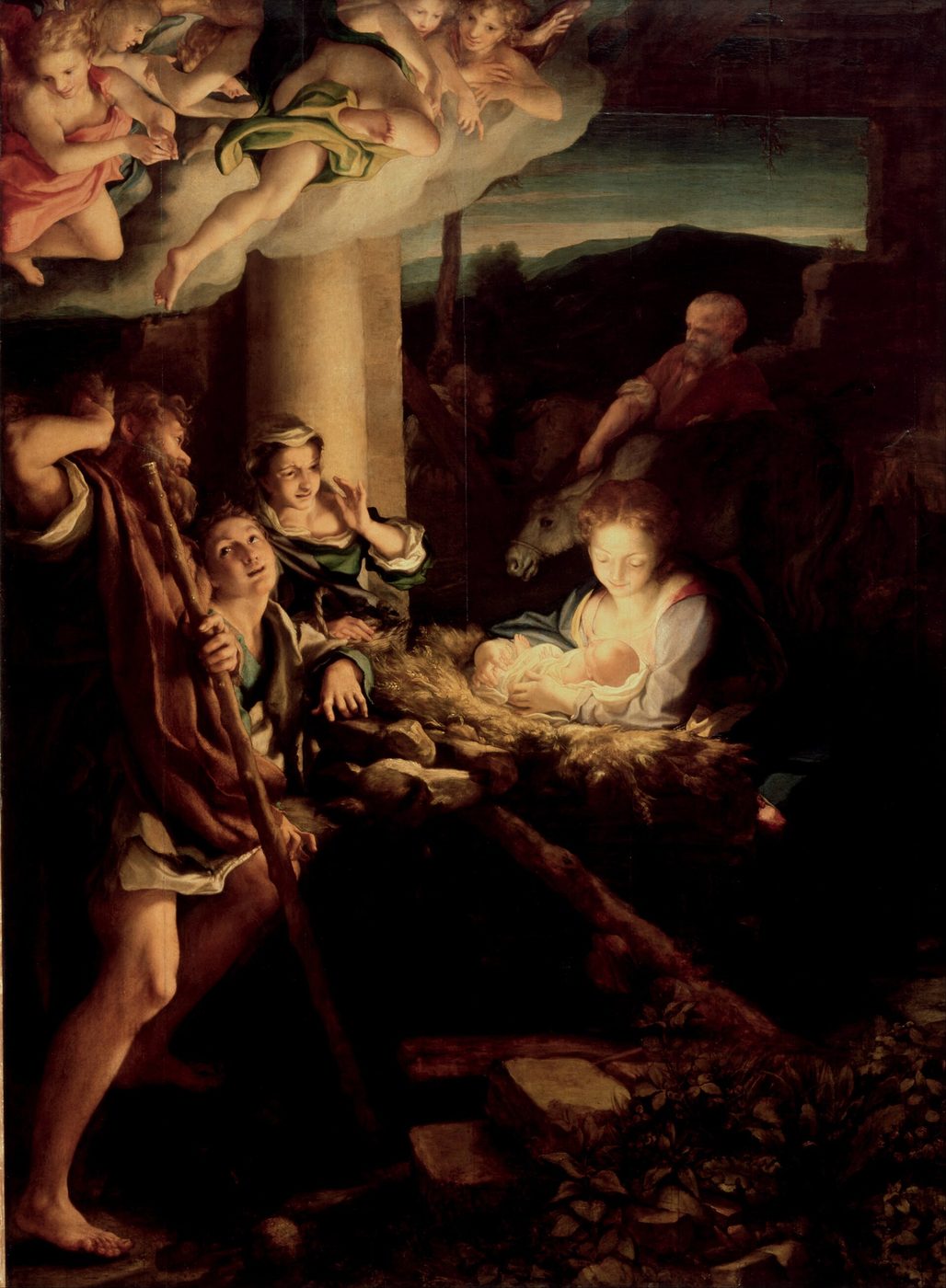
At the Mass during the Day, the Church does not retell the manger scene. She proclaims who the Child is: the eternal Word, through whom all things were made, who became flesh and made His dwelling among us.
Mass Readings
- First Reading Isaiah 52:7-10
- Responsorial Psalm Psalm 98:1, 2-3, 3-4, 5-6
- Second Reading Hebrews 1:1-6
- Gospel John 1:1-18
Open the Mass Readings on USCCB.org →
First Reading Isaiah 52:7-10
How beautiful are the feet of the messenger who announces peace. The Lord has comforted His people; all the ends of the earth will see the salvation of our God.
Psalm Psalm 98
All the ends of the earth have seen the saving power of God. Sing to the Lord a new song.
Second Reading Hebrews 1:1-6
In times past God spoke through the prophets; in these last days He has spoken to us through His Son, the radiance of His glory, whom all the angels worship.
Gospel John 1:1-18
In the beginning was the Word, and the Word was God. The Word became flesh and made His dwelling among us, and we saw His glory, full of grace and truth.
Step Into the Story
Isaiah’s runner sprints over the mountains with news for a ruined city. Nebuchadnezzar had burned Jerusalem and its Temple in the summer of 586 B.C.; in 539 B.C. Cyrus the Persian took Babylon and let the exiles go home, and the watchmen on the broken walls shout for joy. Hebrews, probably written before Rome destroyed the Temple in 70 A.D., opens with God, who once spoke through prophets, now speaking through a Son. John’s Gospel, likely the last written, begins where Genesis begins: “In the beginning.”
- 586 B.C.Babylon burns Jerusalem
- 539 B.C.Cyrus takes Babylon
- 40 B.C.Rome names Herod king
- 27 B.C.Octavian becomes Augustus
- This week’s scene: 6 to 4 B.C.Christ born in Bethlehem
Come to Bethlehem, most likely between 6 and 4 B.C., while Caesar Augustus rules the world and old Herod still sits in Jerusalem, six miles up the road. Bethlehem is a small hill town of David’s clan, its slopes honeycombed with limestone caves where families stable their animals. Rome was keeping December 25 as Christ’s birthday by 336 A.D., but Scripture names no season, so leave the weather to God.
Stoop into one of those caves, as Christians since St. Justin Martyr, around 155 A.D., have remembered it. Smell the animals, the straw and the smoke of a small lamp. A stone feeding trough has become a cradle. Kneel by it. John tells us who lies there: the Word who made the stars has pitched His tent among us. Look at the Child, and be still.
Encounter the Lord
Stand before the manger and look closely at the Child. John’s Gospel tells you who He is: the Word who was with God in the beginning, through whom everything was made. The hands too small to grasp a finger made the stars.
God did not send a message about Himself. He came Himself. The eternal Son took a human body, a human mind and a human heart so that He could heal what was sick in us, raise what had fallen, and bring life where there was death. John says that to those who accepted Him He gave power to become children of God. Christmas is not only something that happened to Him. It is meant to happen in you.
Go to Mass today. At the words of the Creed, “and by the Holy Spirit was incarnate of the Virgin Mary, and became man,” kneel, as the Church asks on this day, and thank Him for coming.
Know Your Faith
- 456-460, 466·“Why did the Word become flesh?”
- 461-463, 470-478·the Incarnation
- 437, 525-526·the Christmas mystery
- 439, 496, 559, 2616·Jesus is the Son of David
- 65, 102·God has said everything in his Word
- 333·the incarnate Christ worshipped by the angels
- 1159-1162, 2131, 2502·the Incarnation and images of Christ
- 9·what God shows us in sending His Son
- 76·why God became man
- 77·Jesus Christ, true God and true man
Why the Word Became Flesh
The Word became flesh to save us by reconciling us with God, so that we might know God’s love, to be our model of holiness, and to make us partakers of the divine nature (CCC 457-460).
True God and True Man
The Church calls “Incarnation” the fact that the Son of God assumed a human nature to accomplish our salvation in it (CCC 461). Belief in the true Incarnation is the distinctive sign of Christian faith (CCC 463).
God’s Final Word
In His Son, the Father’s one, perfect Word, God has said everything; there will be no other word than this one (CCC 65). Through all the words of Scripture, God speaks one single Word (CCC 102).
Glory to God in the Highest
The life of the Word made flesh is surrounded by the adoration and service of angels; their song at His birth still resounds in the Church’s “Glory to God in the highest” (CCC 333). Christmas is a holy day of obligation (CCC 2177, 2180).
Key Takeaways
- Scripture
- Doctrine
- Sacraments
- Christian Life


- Doctrine: Jesus is the eternal Son of God, who existed before He was born in Bethlehem.
- Doctrine: At Christmas the Son of God became a real human being without ceasing to be God.
- Doctrine: God became man to save us, to show us His love, to teach us holiness, and to share His divine life with us.
- Scripture: In Jesus, God has said everything He wants to reveal to us.
Test Your Knowledge
True or false? Tap your answer.
John’s Gospel teaches that the Word existed before creation.
True.
At the Incarnation the Son of God stopped being God for a time.
False: He assumed a human nature without ceasing to be God, CCC 464.
One reason the Word became flesh was to make us partakers of the divine nature.
True.
The Letter to the Hebrews teaches that the Son is greater than the angels.
True.
Christians should expect a later public revelation that completes what God said in Christ.
False: in His Son God has said everything; there will be no other word, CCC 65.
Belief in the true Incarnation is the distinctive sign of Christian faith.
True.
Isaiah’s messenger announces that the Lord has comforted His people and redeemed Jerusalem.
True.
Christmas is a holy day of obligation.
True.
The Mass during the Day centers mainly on the shepherds at the manger.
False: it proclaims John’s prologue, the Word made flesh.
According to John, those who accept the Word receive power to become children of God.
True.
Answers: 1 T · 2 F (He assumed a human nature without ceasing to be God, CCC 464) · 3 T · 4 T · 5 F (in His Son God has said everything; there will be no other word, CCC 65) · 6 T · 7 T · 8 T · 9 F (it proclaims John’s prologue, the Word made flesh) · 10 T
Journal Prompts
What does it mean to me that the One lying in the manger is the Creator of the world?
Where in my life do I most need Christ to heal, to raise up or to bring life?
How have I “seen His glory” this past year?
How can I make room for Christ to be born more fully in me this Christmas?
Talk to God
Lord Jesus, eternal Word of the Father, You became a child for love of us. I adore You. Heal what is wounded in me, raise what has fallen, and make me a child of God. Glory to You! Amen.