Sunday, July 4, 2027 · Year B
Fourteenth Sunday in Ordinary Time
Power is made perfect in weakness
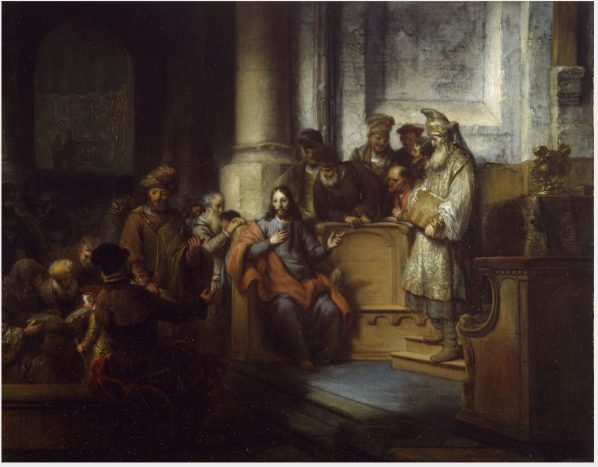
God sends Ezekiel to a rebellious people: whether they listen or not, they will know a prophet has been among them. Paul learns that God’s grace is enough, for power is made perfect in weakness. In Nazareth, Jesus’ own townspeople take offense at Him, and He is amazed at their lack of faith.
Mass Readings
- First Reading Ezekiel 2:2-5
- Responsorial Psalm Psalm 123:1-2, 2, 3-4
- Second Reading 2 Corinthians 12:7-10
- Gospel Mark 6:1-6
Open the Mass Readings on USCCB.org →
First Reading Ezekiel 2:2-5
The Spirit enters Ezekiel and sets him on his feet. God sends him to the rebellious Israelites, hard of face and obstinate of heart: whether they heed or resist, they shall know that a prophet has been among them.
Psalm Psalm 123
Our eyes are fixed on the Lord, pleading for His mercy.
Second Reading 2 Corinthians 12:7-10
Paul was given a thorn in the flesh. Three times he begged the Lord to remove it, but the Lord said, “My grace is sufficient for you, for power is made perfect in weakness.” So Paul boasts of his weaknesses: when I am weak, then I am strong.
Gospel Mark 6:1-6
Jesus teaches in the synagogue at Nazareth. His neighbors are astonished but take offense: “Is he not the carpenter, the son of Mary?” Jesus says a prophet is not without honor except in his native place. He works few mighty deeds there because of their lack of faith.
Step Into the Story
Ezekiel was carried to Babylon with the first wave of exiles in 597 B.C., and around 593 B.C., by the Chebar canal, God called him to speak to a “rebellious house.” Whether they listen or not, God says, they will know a prophet has been among them. Paul, writing around 56 A.D., tells Corinth of a “thorn in the flesh” he begged God three times to remove. Nobody knows what it was. God’s answer was no.
- 597 B.C.Ezekiel taken to Babylon
- c. 593 B.C.Ezekiel called by the Chebar
- 4 B.C.Romans burn Sepphoris
- 14 A.D.Tiberius becomes emperor
- This week’s scene: late 20s A.D.Rejected at Nazareth
Walk up into Nazareth on a Sabbath in the late 20s A.D. It is a hill village of perhaps a few hundred people, and everyone knows everyone. Four miles north, across the valley, Herod Antipas has rebuilt Sepphoris, burned by the Romans in 4 B.C., and made it the ornament of Galilee. Here there are only terraces, a spring and plain houses. Today no one works. Families climb the lanes in their best cloaks.
Squeeze onto a bench in the little synagogue among the neighbors. Jesus rises to teach, and the murmur starts: “Is he not the carpenter, the son of Mary?” They know His brothers’ names; His sisters sit among them. The Greek word tekton means a builder in wood or stone. Watch the faces turn from wonder to resentment. Then watch His.
Encounter the Lord
Sit in the little synagogue of Nazareth. The young man reading is the carpenter you have known for thirty years. You bought a table from Him. His words are astonishing, but you think, “Who does He think He is?”
Familiarity can close our hearts. We can know Jesus so well from childhood that we stop listening, and miss the miracles He wants to work. Paul learned another lesson: God often works most powerfully not by removing our weaknesses but through them. St. Thomas More, writing from prison before his execution, trusted that nothing could come but what God wills, and that it would be for the best. That is faith in the middle of weakness.
Name one weakness you have asked God to remove. This week, offer it to Him instead and pray, “Your grace is sufficient for me.”
Know Your Faith
- 313·why a sinner turns to God
- 49·whether God guides the world and my life
- 20·how we respond when God speaks
The Prophets Call to Conversion
The prophets call to conversion of heart and, in seeking God’s face, intercede for the people (CCC 2581-2584). Christ shares His prophetic office with the whole People of God (CCC 436, 904).
Christ the Prophet
Jesus was anointed by the Spirit as prophet, priest and king (CCC 436). His own people rejected Him, but His word remains the truth (CCC 548).
Persevering in Faith
To live, grow and persevere in faith until the end, we must nourish it with the word of God, beg the Lord to increase it, and let it work through charity (CCC 162).
Power in Weakness
God’s almighty power is shown in its fullness in the apparent weakness of the Cross (CCC 268, 272). The sick can unite their sufferings to Christ, whose power works through weakness (CCC 1508).
Key Takeaways
- Scripture
- Doctrine
- Sacraments
- Christian Life


- Scripture: God sends prophets even to people who refuse to listen.
- Christian Life: Familiarity with Jesus can lead to taking Him for granted.
- Doctrine: God’s power often works through our weaknesses.
- Christian Life: Faith must be nourished through Scripture, prayer and charity to persevere.
Test Your Knowledge
True or false? Tap your answer.
Ezekiel was sent to a rebellious people.
True.
God removed Paul’s thorn in the flesh after he prayed three times.
False: God said, “My grace is sufficient for you”.
The people of Nazareth called Jesus “the carpenter, the son of Mary.”
True.
Jesus worked many mighty deeds in Nazareth.
False: He worked few because of their lack of faith.
Jesus said a prophet is not without honor except in his native place.
True.
The Catechism teaches that faith needs to be nourished to persevere.
True.
Ezekiel was taken into exile in Babylon.
True.
Paul says, “When I am weak, then I am strong.”
True.
The Church teaches that Mary had other children after Jesus.
False: Mary remained ever virgin; “brothers” can mean close relatives, CCC 499-500.
God’s power is revealed in the apparent weakness of the Cross.
True.
Answers: 1 T · 2 F (God said, “My grace is sufficient for you”) · 3 T · 4 F (He worked few because of their lack of faith) · 5 T · 6 T · 7 T · 8 T · 9 F (Mary remained ever virgin; “brothers” can mean close relatives, CCC 499-500) · 10 T
Journal Prompts
Where have I grown so familiar with Jesus that I stop listening?
What weakness do I need to offer to God rather than hide?
How do I respond to prophetic voices that challenge me?
Do I trust, like St. Thomas More, that God can bring good out of everything?
Talk to God
Lord Jesus, Your own people did not accept You. Give me a heart that listens and believes. When I am weak, let Your grace be enough for me, and let Your power work through my weakness. Amen.