Sunday, July 25, 2027 · Year B
Seventeenth Sunday in Ordinary Time
Gather the fragments left over, so that nothing will be wasted
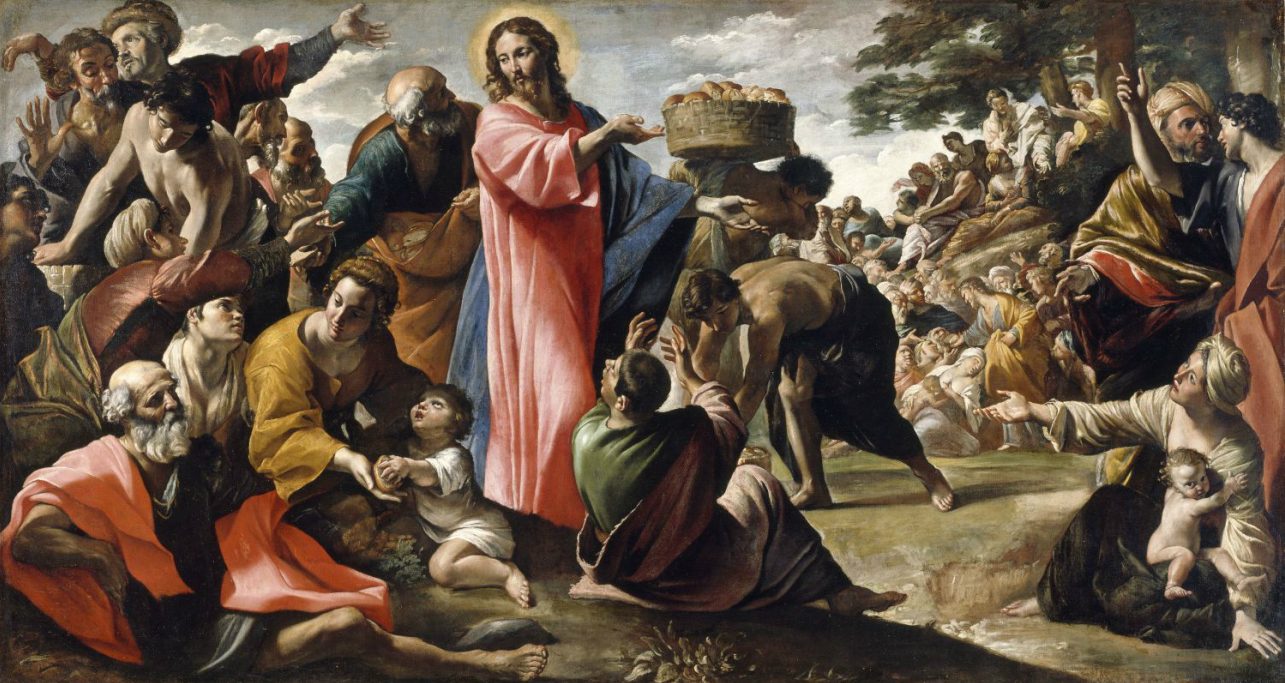
Elisha feeds a hundred men with twenty barley loaves, and there is some left over. By the Sea of Galilee, a boy offers five barley loaves and two fish. Jesus gives thanks and distributes them to five thousand, and twelve baskets of fragments are gathered. The Church reads John 6 for the next five Sundays.
Mass Readings
- First Reading 2 Kings 4:42-44
- Responsorial Psalm Psalm 145:10-11, 15-16, 17-18
- Second Reading Ephesians 4:1-6
- Gospel John 6:1-15
Open the Mass Readings on USCCB.org →
First Reading 2 Kings 4:42-44
A man brings Elisha twenty barley loaves. Elisha says to give them to the people. His servant objects that it cannot feed a hundred, but they eat and have some left over, as the Lord said.
Psalm Psalm 145
The hand of the Lord feeds us; He answers all our needs.
Second Reading Ephesians 4:1-6
Live in a manner worthy of your call, with humility, gentleness and patience, bearing with one another in love. There is one body and one Spirit, one Lord, one faith, one baptism, one God and Father of all.
Gospel John 6:1-15
A large crowd follows Jesus. Philip says two hundred days’ wages would not buy enough bread. Andrew finds a boy with five barley loaves and two fish. Jesus gives thanks and distributes them; all are satisfied, and twelve baskets of fragments remain. The people want to make Him king, and He withdraws to the mountain alone.
Step Into the Story
Elisha worked in the northern kingdom in the ninth century B.C., a hungry age. A man arrives with twenty barley loaves from the first harvest, and Elisha orders them shared among a hundred men; there is food left over. Barley ripened first, around Passover, and it was the bread of the poor. Paul, a prisoner as he writes to Ephesus, likely in the early 60s, urges “one Lord, one faith, one baptism.”
- 9th c. B.C.Elisha feeds a hundred men
- 4 B.C.Antipas rules Galilee
- 14 A.D.Tiberius becomes emperor
- c. 20 A.D.Antipas founds Tiberias
- This week’s scene: c. 29 A.D.Five thousand are fed
Climb the hillside on the far shore of the lake John calls the Sea of Tiberias, after the city Herod Antipas founded around 20 A.D. and named for the emperor. It is spring, likely 29 A.D., and Passover is near. John notes there is a great deal of grass, so the slopes are green and soft underfoot.
Sit down in the grass with the others as the disciples group the crowd. Count the men: about five thousand. Philip frets that two hundred days’ wages would not buy enough bread. Andrew has found a boy with five barley loaves and two fish, likely dried or pickled. Smell the coarse bread. Watch the boy hand them over, and watch Jesus lift them up.
Encounter the Lord
Sit on the grass by the Sea of Galilee among thousands of hungry people. A boy holds out a small basket: five barley loaves and two dried fish. Andrew asks, “What good are these for so many?”
Jesus does not begin with nothing. He takes what a boy offers, gives thanks, and feeds everyone. Your small offering in His hands can do more than you imagine: your time, your talents, your prayer, your money. And notice the words He uses: He took, gave thanks, and distributed. They are the words of the Eucharist. The bread He gives is a sign of the Bread of Life. And St. John Chrysostom warns that those who receive the Lord’s Body must become merciful to the poor.
This week, give something real to someone in need, through your parish, a food bank or a neighbor. Offer it to Jesus first, as the boy offered his loaves.
Know Your Faith
- 212·the names for the Eucharist
- 146·the communion of saints
- 449·what the poor mean for Christians
A Sign of the Eucharist
The miracles of the multiplication of the loaves, when the Lord says the blessing, breaks and distributes the loaves, prefigure the superabundance of this unique bread of His Eucharist (CCC 1335).
One Body, One Spirit
The Church is one: she has one Lord, confesses one faith, is born of one Baptism, forms one Body, and is given life by the one Spirit (CCC 813-815, 866).
Sharing Our Gifts
In the communion of saints, everything the true Christian has is to be regarded as a good possessed in common with everyone else (CCC 949-953). Charisms are graces of the Spirit given for the good of the Church (CCC 951).
The Eucharist and the Poor
The Eucharist commits us to the poor. To receive in truth the Body and Blood of Christ, we must recognize Christ in the poorest, His brethren (CCC 1397).
Key Takeaways
- Scripture
- Doctrine
- Sacraments
- Christian Life


- Sacraments: The multiplication of the loaves foreshadows the Eucharist.
- Christian Life: Jesus can do great things with the small gifts we offer Him.
- Doctrine: The Church is one body with one Lord, one faith and one Baptism.
- Sacraments: Receiving the Eucharist commits us to care for the poor.
Test Your Knowledge
True or false? Tap your answer.
Elisha fed a hundred men with twenty barley loaves.
True.
In John’s account, a boy provided five barley loaves and two fish.
True.
After the meal, nothing was left over.
False: twelve baskets of fragments were gathered.
The Catechism teaches that the multiplication of loaves prefigures the Eucharist.
True.
Ephesians speaks of one Lord, one faith, one baptism.
True.
Jesus accepted the crowd’s attempt to make Him king.
False: He withdrew to the mountain alone.
Barley bread was the bread of the poor.
True.
The Eucharist has no connection to care for the poor.
False: the Eucharist commits us to the poor, CCC 1397.
John notes that the feeding took place near the Passover.
True.
Philip suggested that two hundred days’ wages would be enough to feed the crowd.
False: he said it would not be enough.
Answers: 1 T · 2 T · 3 F (twelve baskets of fragments were gathered) · 4 T · 5 T · 6 F (He withdrew to the mountain alone) · 7 T · 8 F (the Eucharist commits us to the poor, CCC 1397) · 9 T · 10 F (he said it would not be enough)
Journal Prompts
What “five loaves” do I have that I could offer Jesus?
Do I hold back because my gift seems too small?
How does receiving the Eucharist change how I treat the poor?
Where do I need to bear with others in love, as Paul asks?
Talk to God
Lord Jesus, You took five loaves from a boy and fed a multitude. Take the little I have and use it for Your glory. Feed me with the Bread of Life, and make me generous to those in need. Amen.