Monday, November 1, 2027 · Solemnity
All Saints
Rejoice and be glad, for your reward will be great in heaven
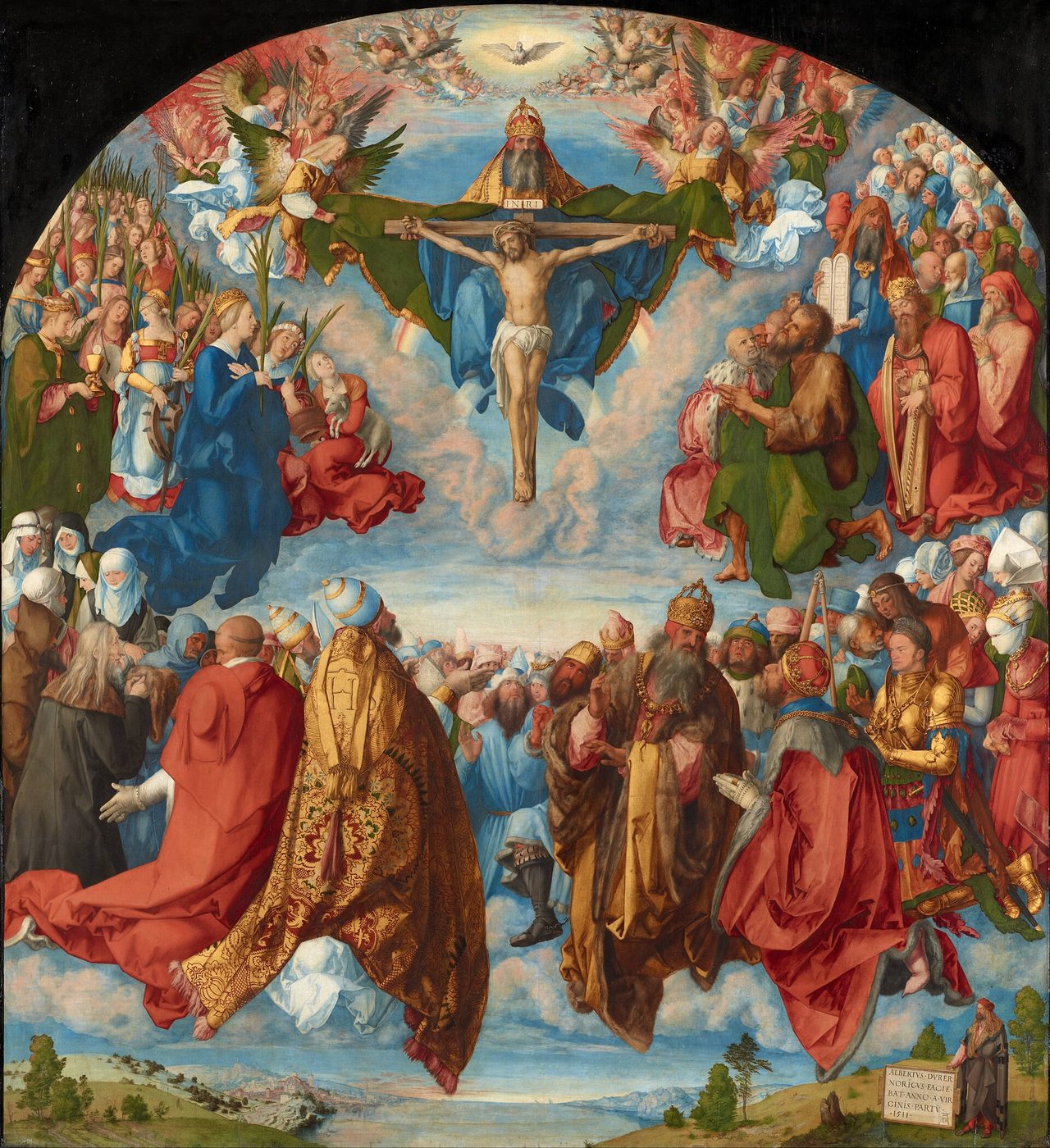
John sees a great multitude from every nation standing before the throne of the Lamb, robed in white. The First Letter of John says we are God’s children now, and we shall be like Him. Jesus teaches the Beatitudes, the path of holiness that leads to heaven.
Mass Readings
- First Reading Revelation 7:2-4, 9-14
- Responsorial Psalm Psalm 24:1bc-2, 3-4ab, 5-6
- Second Reading 1 John 3:1-3
- Gospel Matthew 5:1-12a
Open the Mass Readings on USCCB.org →
All Saints falls on Monday, November 1, 2027. In the United States, when this solemnity falls on a Saturday or a Monday, the obligation to attend Mass is abrogated. The solemnity is still celebrated, and attending Mass remains a beautiful way to honor the saints.
First Reading Revelation 7:2-4, 9-14
John sees a great multitude, which no one could count, from every nation, race, people and tongue, standing before the throne and the Lamb, wearing white robes and holding palm branches. These are the ones who have survived the time of great distress; they have washed their robes in the Blood of the Lamb.
Psalm Psalm 24
Lord, this is the people that longs to see your face.
Second Reading 1 John 3:1-3
See what love the Father has bestowed on us that we may be called the children of God. Yet so we are. We do not yet know what we shall be, but when it is revealed we shall be like Him, for we shall see Him as He is.
Gospel Matthew 5:1-12a
Jesus goes up the mountain and teaches: Blessed are the poor in spirit, those who mourn, the meek, those who hunger and thirst for righteousness, the merciful, the clean of heart, the peacemakers, and those persecuted for the sake of righteousness. Rejoice and be glad, for your reward will be great in heaven.
Step Into the Story
John wrote Revelation on Patmos, likely around 95 A.D., under Domitian, an emperor who liked to be addressed as “lord and god.” He sees a crowd no one could count, from every nation, robed in white, waving palms, the sign of victory carried in Roman triumphs. St. Ephrem the Syrian, who died in 373, knew a common feast for all the martyrs. By the late 300s pilgrims were being shown a hillside near Capernaum as the place of the Beatitudes, with a cave where the Lord had taught.
- 63 B.C.Pompey takes Jerusalem
- 4 B.C.Antipas rules Galilee
- 14 A.D.Tiberius becomes emperor
- 26 A.D.Pilate becomes prefect
- This week’s scene: c. 28 A.D.The Beatitudes
Come north to Galilee with the crowds, in or near 28 A.D., from wherever you started: Jerusalem and Judea, the Greek cities of the Decapolis, or beyond the Jordan. Some have walked for days. Feel the road in your feet. Herod Antipas rules here, and the people around you pay his taxes, the Temple’s tithes and the landlord’s rent.
Matthew gives no season and names no hill, so see only what he tells us: a mountain, a crowd, a Teacher. Jesus climbs a little way and sits down. His disciples come to Him. Find a patch of ground among strangers who have come as far as you. Look at the poor, the grieving, the hungry around you. He opens His mouth. Listen.
Encounter the Lord
Lift your eyes with John and look at the multitude before the throne: so many that no one could count them, from every nation and language. These are the saints, most of them unknown to us: grandmothers, farmers, children, martyrs.
This solemnity reminds you that holiness is not for a few heroes. It is God’s plan for you. The Beatitudes are the portrait of Jesus Himself and the path to that crowd in white. The saints are not distant statues; they are family, members of the one Body of Christ who pray for us. As St. Dominic promised, they help us more after death than they could in life. And John tells you what awaits: we shall be like Him, for we shall see Him as He is.
Choose one saint this week, read about his or her life, and ask for that saint’s intercession. Then choose one Beatitude to practice deliberately.
Know Your Faith
- 146·what the communion of saints is
- 497·why it helps to turn to the saints in prayer
- 342·whether we are all called to be saints
The Communion of Saints
The Church is a communion of holy things and holy persons. All of us who belong to Christ form one Church, united on earth, in purification and in glory (CCC 946-959).
The Intercession of the Saints
Being more closely united to Christ, those who dwell in heaven fix the whole Church more firmly in holiness. They do not cease to intercede with the Father for us (CCC 956, 2683).
The Saints as Examples
By canonizing some of the faithful, the Church recognizes the power of the Spirit of holiness within her and proposes the saints as models and intercessors (CCC 828). The witnesses who have preceded us into the kingdom share in the living tradition of prayer by the example of their lives (CCC 2683-2684).
The Universal Call to Holiness
All Christians in any state or walk of life are called to the fullness of Christian life and to the perfection of charity (CCC 2013). The Beatitudes depict the countenance of Jesus Christ and respond to the natural desire for happiness (CCC 1716-1718).
Key Takeaways
- Scripture
- Doctrine
- Sacraments
- Christian Life


- Doctrine: All the faithful, on earth, in purification and in heaven, form one communion of saints.
- Doctrine: The saints in heaven intercede for us.
- Christian Life: Every Christian is called to holiness.
- Christian Life: The Beatitudes describe Jesus and the path to heaven.
Test Your Knowledge
True or false? Tap your answer.
John saw a multitude that no one could count before the throne.
True.
The multitude in Revelation came from Israel only.
False: they came from every nation, race, people and tongue.
1 John says we are God’s children now.
True.
The Beatitudes are found in Matthew’s Sermon on the Mount.
True.
The Catechism teaches that the saints in heaven cease to pray for us.
False: they do not cease to intercede for us, CCC 956.
Pope Boniface IV dedicated the Pantheon to Mary and all the martyrs.
True.
Holiness is meant only for priests and religious.
False: all Christians are called to holiness, CCC 2013.
In the United States, the obligation to attend Mass is abrogated when All Saints falls on a Monday.
True.
The white-robed multitude washed their robes in the Blood of the Lamb.
True.
The Catechism teaches that the Beatitudes depict the countenance of Jesus Christ.
True.
Answers: 1 T · 2 F (they came from every nation, race, people and tongue) · 3 T · 4 T · 5 F (they do not cease to intercede for us, CCC 956) · 6 T · 7 F (all Christians are called to holiness, CCC 2013) · 8 T · 9 T · 10 T
Journal Prompts
Which saint do I feel close to, and why?
Do I believe that God wants me to be a saint?
Which Beatitude do I most need to live this week?
Whom do I know who has died faithfully and may already be among the saints?
Talk to God
Lord God, You call me to holiness and surround me with the saints. Through their prayers, help me walk the path of the Beatitudes and bring me into that great multitude before Your throne, to see You. Amen.